Forging is a metal processing method. It refers to the process of applying pressure to a metal billet using equipment such as hammers and presses, causing it to undergo plastic deformation to obtain the desired shape, size, and mechanical properties. This article mainly introduces the types of forging to help our customers better select the appropriate forging method.
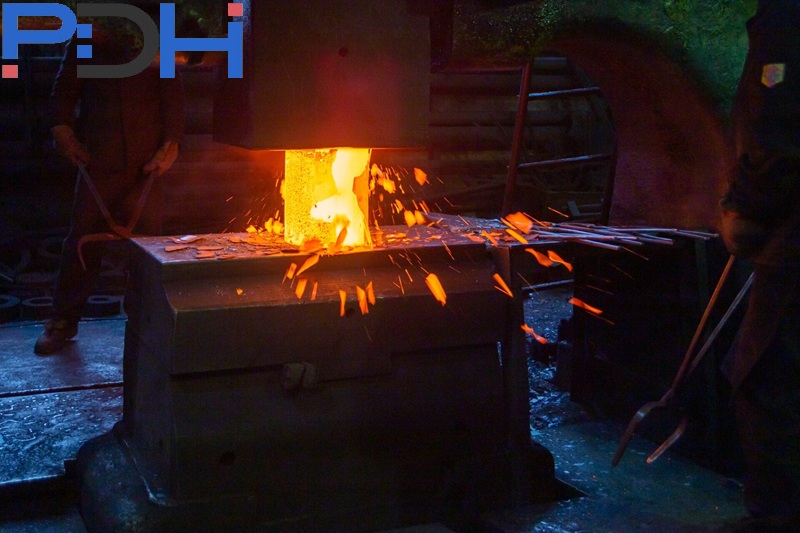
Classification by Forming Temperature
Based on the recrystallization temperature of the metal, forging can be classified into hot forging, warm forging, and cold forging.
1. Hot Forging:
Hot forging refers to forging performed at temperatures above the metal’s recrystallization temperature (usually 0.6 times or more above the melting point). At high temperatures, the metal has good fluidity and low deformation resistance. It is suitable for forming large or complex-shaped parts and does not produce work hardening. The disadvantages are severe surface oxidation and generally lower dimensional accuracy.
2. Cold Forging:
Cold forging refers to forging performed at room temperature. Because it is not heated, the material surface quality is good, the dimensional accuracy is extremely high, and the metal flow lines are intact, and the strength increases after deformation. The disadvantages are high deformation resistance, requiring large-tonnage equipment, and good material plasticity. It is suitable for small and medium-sized parts (such as standard parts and gears).
3. Warm Forging
Warm forging refers to forging at temperatures between cold and hot forging (typically 0.3-0.5 times the recrystallization temperature). It aims to balance the advantages and disadvantages of hot and cold forging. It offers higher precision and less oxidation than hot forging, and lower deformation resistance and better plasticity than cold forging. It is often used for high-strength steels or complex-shaped parts that are difficult to form by cold forging. Sometimes it serves as a pretreatment step for cold forging.
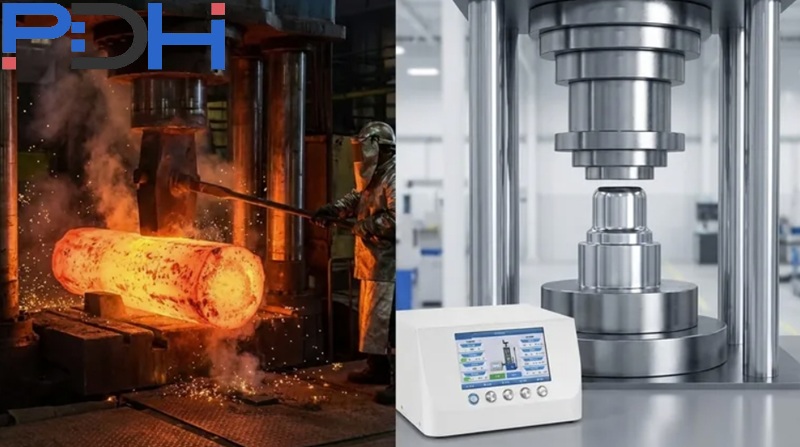
Classification by Mold and Deformation Method
Based on the flow pattern of metal within the mold cavity, forging can be classified into die forging, multi-directional die forging, hollow die forging, and multi-directional hollow die forging.
1. Die Forging
Die forging refers to the process where metal billets are forced to flow within the cavity of a specific mold under external force, thus filling the mold cavity and forming the desired shape. Unlike free forging, die forging is more efficient, dimensionally precise, and can produce complex shapes. Traditional die forging typically relies on a hammer or press for unidirectional (up and down) movement.
2. Multi-directional Forging
A precision die forging process that applies pressure to metal simultaneously in multiple directions. Traditional die forging has only one vertical movement direction, easily resulting in large flash at the parting line. Multi-directional die forging utilizes multiple punches to jointly extrude metal from different directions (such as horizontal and vertical), ensuring the metal fills the cavity effectively.
Advantages:
- Eliminates transverse flash, resulting in high material utilization (up to 90% or more).
- Enables the forming of complex integral structural components with lateral holes, lateral bosses, or internal hollow structures (such as high-pressure valve bodies and tee fittings).
- Avoids subsequent welding or cutting.
3. Hollow Forging
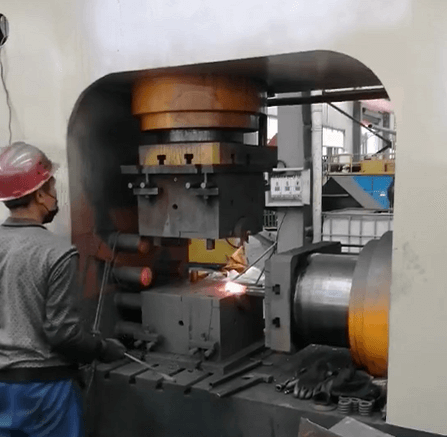
Strictly speaking, this isn’t a separate major category, but rather a process description for specific parts. Hollow forging is mainly used to produce long shafts, cylindrical parts, or hollow parts with raised bottoms. It combines extrusion and forging, using a punch to pierce and stretch the billet, causing the metal to flow axially and thin the wall thickness. Typical applications include artillery shell casings, high-pressure gas cylinders, and rocket fuel tanks.
4. Multi-directional Hollow Forging
This is an advanced combination of multi-directional forging and hollow forging technologies, representing the high-end form of precision forging.
Through the coordinated movement of multiple punches (including vertical and horizontal directions), it simultaneously forms complex hollow structural parts while creating lateral holes, flanges, or internal flow channels.
For parts with complex internal cavities, lateral openings, and requiring a seamless, weld-free design (such as complex aerospace joints and high-pressure common rail pipes), traditional processes struggle to achieve one-time forming, while “multi-directional + hollow” can achieve near-net-shape forming, significantly improving the strength and reliability of the parts.
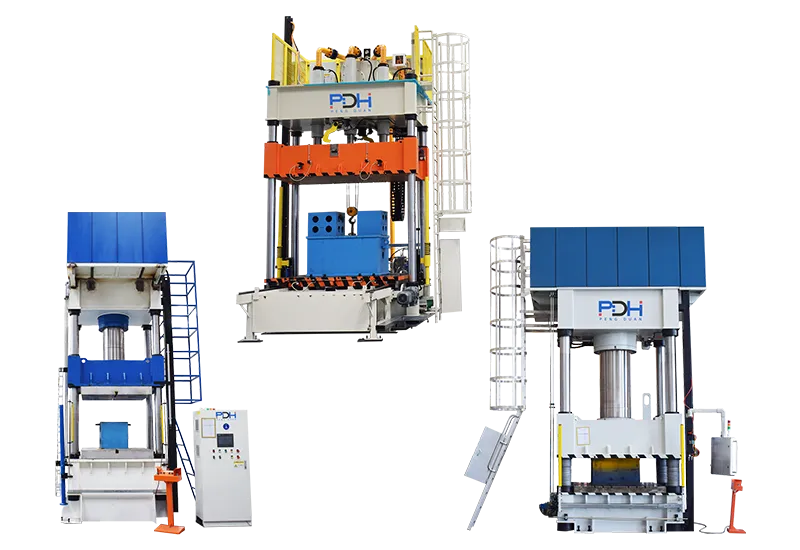
As a well-known forging press manufacturer in China, PDH offers a variety of high-quality forging presses, including die forging machines, multi-directional forging presses, hot forging presses, and cold forging presses. Please contact us if you have any needs.