Forging is an important metal processing method. Depending on the temperature chosen, it can be divided into cold forging and hot forging. They differ in temperature, process characteristics, equipment configuration, material properties, and application scenarios. The following will compare cold forging and hot forging from these aspects to provide a better understanding of them.
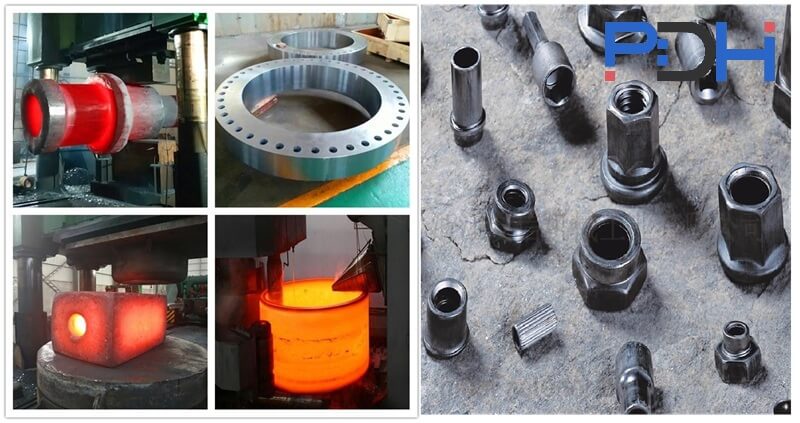
1. Temperature Range
Hot Forging
Hot forging is a forging process performed at high temperatures. It typically requires heating the metal to near or above its recrystallization temperature. The temperature range varies depending on the material.
For carbon steel, the heating temperature is usually controlled between 110°C and 125°C. At this temperature, the atomic mobility of the metal is significantly enhanced, and the originally compact crystal structure becomes looser, much like the increased ductility of clay after heating. Workers need to wear heat-resistant gloves and use hydraulic presses or forging hammers to shape the red-hot metal billet.
Cold Forging
Cold forging is a forging process performed at or slightly above room temperature (not exceeding the metal’s recrystallization temperature). It generally refers to the plastic deformation of metal materials at room temperature.
For aluminum alloy processing, the temperature is mostly maintained in the range of 20°C-150°C. The metal retains high strength at room temperature. During shaping, a heavy-duty press of 800 tons or more is required to apply continuous pressure. The workshop needs to be equipped with a vibration-damping foundation.
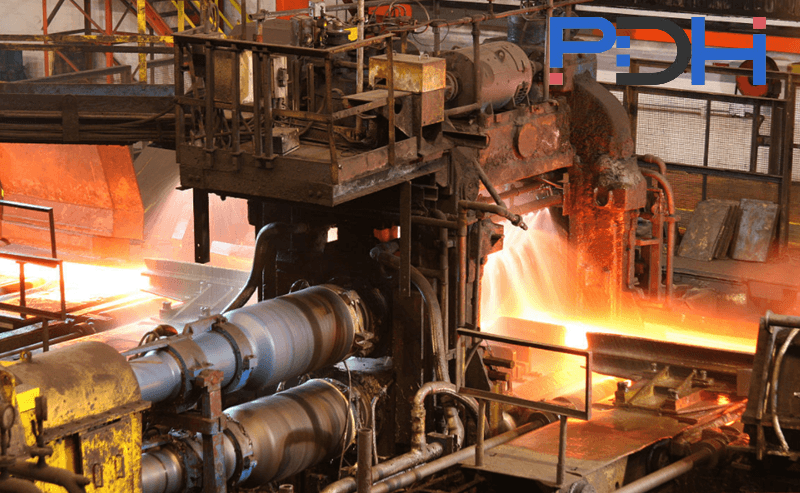
2. Process Characteristics
Hot Forging
Hot forging is performed at high temperatures, which improves the plasticity of metal materials, reduces stress and power requirements, and lightens equipment load. Hot forging promotes grain growth and rearrangement within the material, improving its toughness and ductility. Simultaneously, hot forging eliminates residual stress within the material, improving dimensional accuracy and surface quality. However, hot forging is prone to oxidation and burning, requiring appropriate protective measures.
Cold Forging
This process allows for dimensional accuracy control within +0.05mm, achieving a mirror-like surface finish. It is particularly suitable for manufacturing miniature precision parts such as watch gears. Cold forging offers faster cooling, effectively improving the material’s strength, hardness, and texture uniformity. However, cold forging requires greater force for plastic deformation, easily leading to cracking and uneven deformation.
3. Equipment Configuration Comparison
Investment in production lines is often a key decision.
| Equipment Components | Hot forging production line | Cold forging production line |
| Main Unit Type | Hot forging press or forging hammer | High-rigidity cold forging press, multi-station cold heading machine |
| Heating System | Must be equipped with induction heating furnace or gas furnace | No heating system required |
| Mold Material | Heat-resistant steel (such as H13), must possess extremely high red hardness | High-hardness tool steel/hard alloy, emphasizing wear resistance |
| Lubrication System | Primarily graphite lubricant, large ambient temperature rise | Phosphating, saponification, or special synthetic lubricants |
| Automation | equires high-temperature resistant robots or manipulators | High-speed mechanical transmission or industrial robots |
4. Material Properties
Not all metals are suitable for either process; materials behave very differently at different temperatures.
Hot Forging Materials:
This includes almost all metals, including high-alloy steels, superalloys, and titanium alloys. Because high temperatures reduce yield strength, the material’s brittleness decreases, making it less prone to cracking.
Cold Forging Materials:
Mainly low-to-medium carbon steels, aluminum alloys, copper, and some stainless steels with good plasticity.
Note: Steels with a carbon content exceeding 0.45% typically require spheroidizing annealing before cold forging to prevent the cold working die from cracking or the parts from splitting.
5. Application Scenarios Segmentation
Based on the end use of the workpiece, application scenarios are clearly defined.
Hot Forging Applications
- Heavy-duty power transmission: Crankshafts, connecting rods, and heavy-duty gears for large commercial vehicles.
- Structural load-bearing components: Aircraft landing gear brackets, large flanges, and valve bodies.
- Mining machinery: Excavator gear blocks and high-strength connecting plates.
Cold Forging Applications
- Precision fasteners: Automotive 10.9/12.9 grade high-strength bolts and irregularly shaped nuts.
- Small parts for transmission systems: Gearbox synchronizer rings, planetary gear shafts, and constant velocity joint (CVJ) housings.
- Electronics and communications: 5G base station heat sinks and fiber optic connector housings.
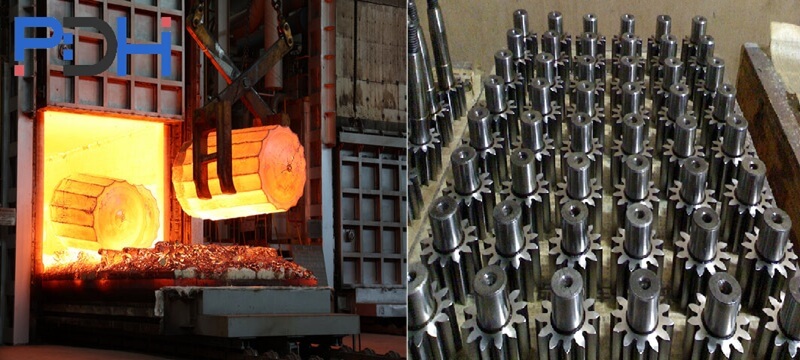
PDH is a professional manufacturer of forging presses, providing not only high-quality cold and hot forging presses but also professional knowledge related to forging presses. Please contact us if you have any questions.