Ballistic helmets primarily consist of a shell, a liner, and a suspension system. The shell absorbs impact energy from projectiles or high-speed shrapnel primarily through deformation and structural failure. Consequently, the manufacturing process for the helmet shell plays a critical role in its protective performance.
Currently, the manufacturing of ballistic helmet shells predominantly employs composite material molding technologies, including hand lay-up, resin transfer molding (RTM), compression molding, and net-shape molding.
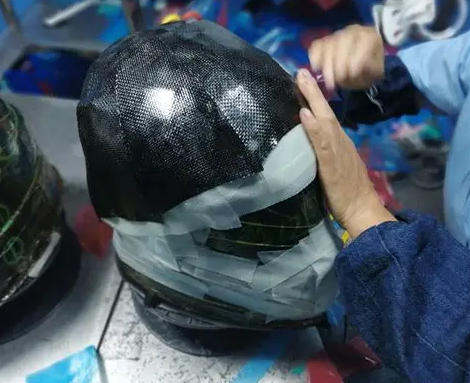
1. Hand Lay-up Molding Process
The hand lay-up molding process, also known as contact molding, is one of the earliest and most widely used techniques for manufacturing composite ballistic helmets. This process relies primarily on manual labor, placing high technical demands on the operators. Operators must understand the product’s structural properties and have specialized knowledge of cutting and laying up fiber-reinforced materials, as well as mold surface preparation.
The hand lay-up process offers low mold costs, easy maintenance, and flexibility in product size and shape. The design can be readily adjusted in specific areas to meet product requirements. Furthermore, the molding process can be conveniently carried out at room temperature. However, it is generally suitable only for producing smaller items. Additionally, the mechanical properties of the finished products tend to be non-uniform, resulting in poor consistency and unstable protective performance.
2. Resin Transfer Molding (RTM)
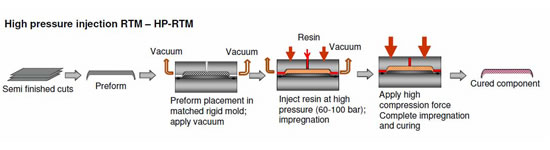
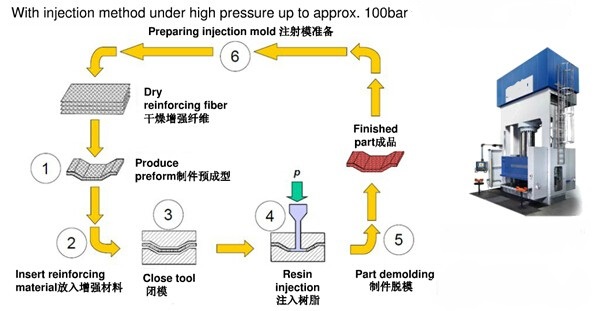
Resin Transfer Molding (RTM) is a composite material molding process in which a low-viscosity resin—such as polyester or epoxy—is injected into a closed mold. The resin thoroughly and uniformly impregnates high-performance fibers or other reinforcement materials, which are then cured to form the final component.
Compared with traditional hand lay-up, RTM produces materials with superior impact resistance and more consistent mechanical properties throughout the structure. Furthermore, the process lowers costs, enables repeatable production, ensures high dimensional accuracy, and produces a smooth, even surface finish.
However, when manufacturing complex or large-scale composite components, RTM can encounter challenges such as uneven resin flow, inadequate fiber impregnation, and excessively long molding cycles. These issues can lead to composite products that fall short of expectations regarding mechanical performance, strength, and dimensional precision.
3. Hot-Press Molding Process
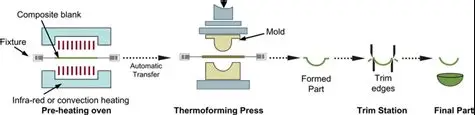
Hot-press molding is one of the most widely used manufacturing processes for composite materials. The main factors that affect the quality of a molded ballistic helmet are molding temperature, molding duration, and molding pressure.
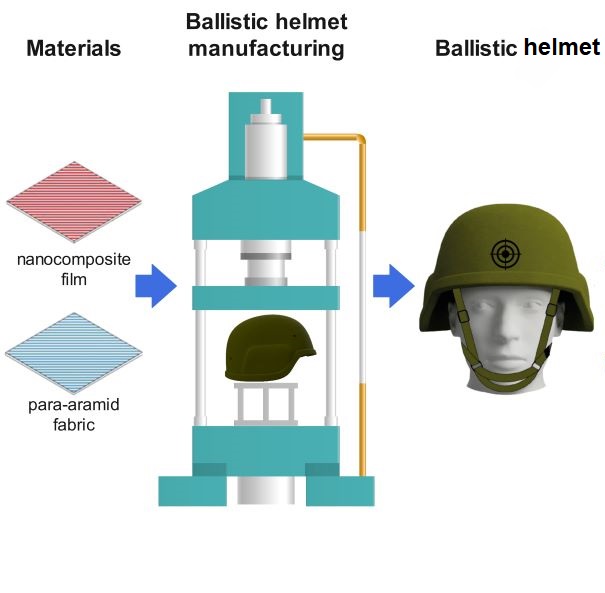
The process begins by preparing a prepreg from selected high-performance fibers and either a thermosetting or thermoplastic resin. The mold is then preheated and maintained at a specific temperature. Operators place the prepreg into the mold of a hydraulic composite molding press, then clamp the edges and close the mold. The mold is heated to the required molding temperature, pressurized, held at that temperature, then cooled and opened. Finally, workers remove the finished product and trim it.
Throughout the hot-press molding process, molding conditions must be strictly monitored. For instance, the curing temperature for UHMWPE composite helmets typically does not exceed 130°C.
4. Near-Net-Shape Forming Technology
Near-net-shape forming technology—also known as gel casting—is an advanced shaping method widely used in ceramics and metal-matrix composites.
The process uniformly mixes ceramic or metal powders with additives, including organic monomers and cross-linking agents, to form a slurry. Once poured into a mold, an initiator triggers monomer polymerization, causing the slurry to gel in situ and solidify into the desired shape.
This technology is highly effective for producing components with complex geometries and high dimensional precision. The resulting green bodies exhibit excellent uniformity and high strength, which helps minimize the need for subsequent machining. However, the process imposes extremely strict requirements regarding raw material purity and the control of operational parameters.
The following are the 4 primary molding technologies for composite-material ballistic helmets:
1) Hand lay-up molding: Products manufactured via this process exhibit inconsistent mechanical properties and lower production efficiency, though the initial investment cost is low. It suits small-batch production or personalized customization.
2) Resin Transfer Molding (RTM): This process yields products with excellent mechanical properties and offers higher production efficiency, with a moderate level of investment. It balances the needs of both batch production and customization.
3) Hot-press molding: Products created through this process possess superior mechanical properties, though production costs are high. It is ideal for standardized, large-scale mass production.
4) Net-shape molding: This technology produces components with high preform strength and high production efficiency, albeit at a higher manufacturing cost. It is designed to fabricate complex parts that demand exceptional dimensional precision and high mechanical performance.
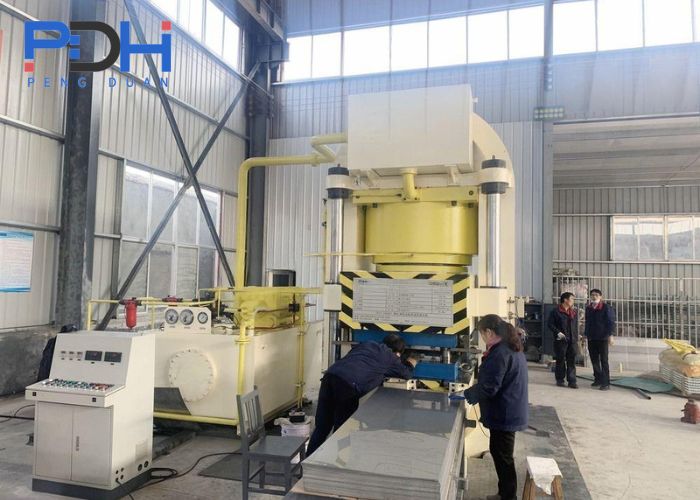
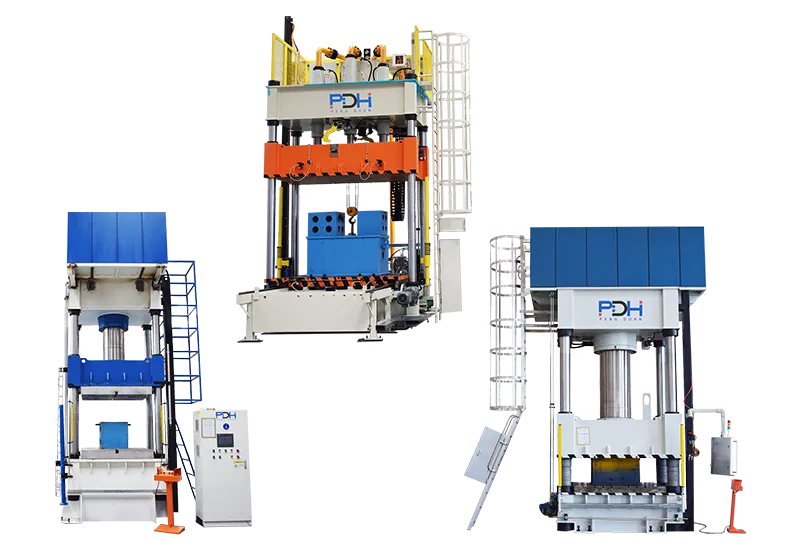
PDH is a prominent Chinese manufacturer of hydraulic presses. We provide specialized presses and molds for producing ballistic helmets. Please contact us if you require our services.