Hydraulic presses are indispensable core pieces of pressure-processing equipment in fields such as forging, stamping, deep drawing, powder forming, and composite material molding. As the machine’s primary structural framework, the frame bears the total operating load and determines the equipment’s rigidity, precision, load-bearing capacity, and operational flexibility. It is the key factor distinguishing different types of hydraulic presses and determining their suitability for specific production scenarios.
Hydraulic press frames vary significantly in structural design, load-bearing capacity, tonnage range, operating methods, and applicable working conditions. Currently, the mainstream industrial frame designs fall into three categories: four-column, C-frame, and H-frame. A thorough understanding of the structural features and application scenarios of these frame types is essential for enterprises when selecting and utilizing hydraulic presses.

The Core Role of the Hydraulic Press Frame
Composed of components such as crossbeams, uprights, and the machine bed, the frame serves as the structural foundation that bears the loads for the entire hydraulic press. It performs the following functions:
- Withstanding working loads
- Ensuring the overall rigidity of the equipment
- Minimizing deformation and off-center loading
- Guaranteeing precision in die installation
- Extending the equipment’s service life
- Reducing vibration and noise
At the same time, the frame’s configuration determines factors such as the method of workpiece loading and unloading, the equipment’s footprint, maintenance requirements, and overall longevity. Consequently, the quality of the frame design often dictates the performance limits of the hydraulic press.
Hydraulic Press Frame Types
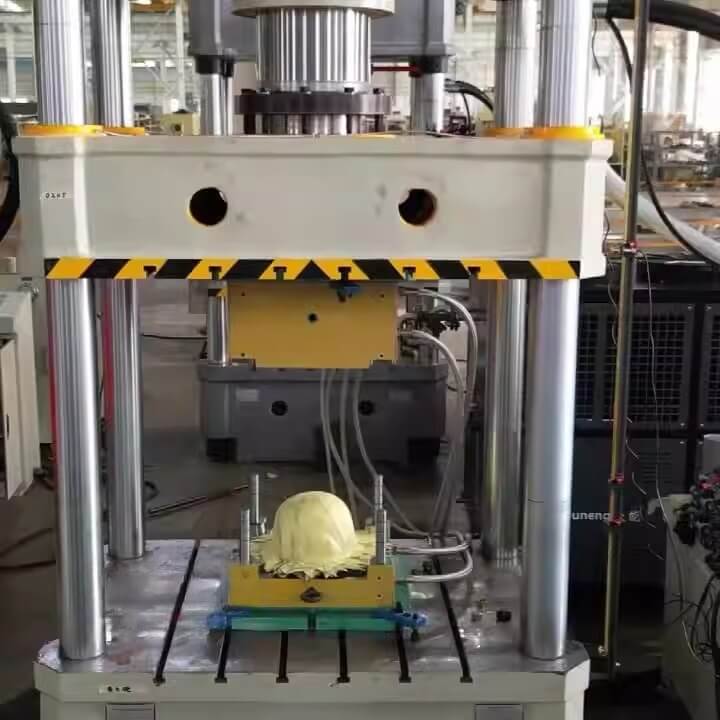
1. Four-Column Hydraulic Press Frame
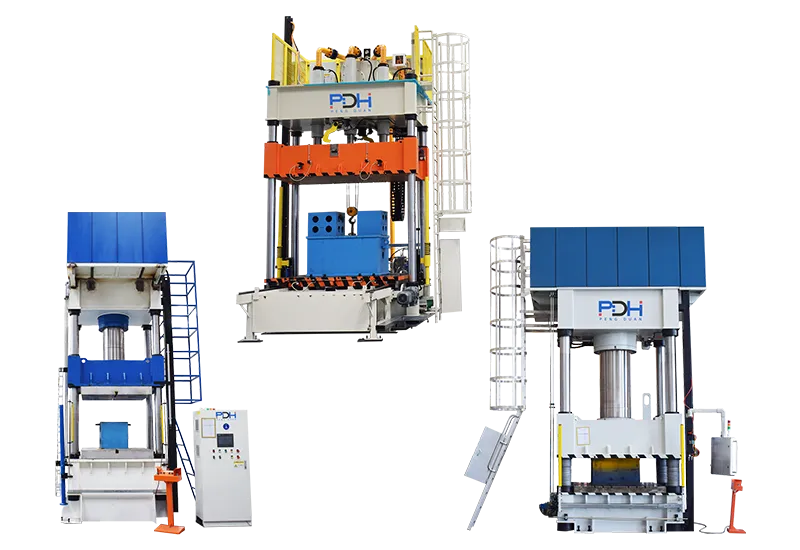
A four-column hydraulic press uses four vertical columns to connect the upper and lower beams and the moving slide. The columns serve the dual functions of structural support and guidance. This frame design offers a simple structure and ample workspace, allowing workpieces to be loaded and unloaded freely from all four sides for operational flexibility. It also facilitates mold changes and integration into automated production lines.
However, the structural integrity of the four-column design relies heavily on the connections between the columns and the beams. Under sustained high-tonnage pressure or off-center loading, the frame’s rigidity is relatively limited, making it prone to beam deformation and loss of guiding precision. This is particularly evident in large-scale presses exceeding 3,000 tons, where the four-column design often falls short of frame-type structures in terms of off-center load resistance and overall stability.
Consequently, this type is better suited for small- to medium-tonnage applications and production scenarios with moderate precision requirements.
2. H Hydraulic Press Frame
The H-frame consists of a rectangular main frame paired with horizontal crossbeams. It typically features either a monolithic welded design or a modular box-type structure, creating an “H” shape. An integrated body design is commonly used, leaving the working area open on two sides.
This frame design balances high tonnage, high precision, and high stability, offering exceptional structural rigidity and resistance to deformation. As a precision heavy-duty frame structure, it is the preferred choice for guided-ram hydraulic presses. H-frame presses feature a compact design and a large worktable area, offering far superior space utilization compared to four-column models.
However, the manufacturing process for the H-frame is complex, requiring extensive welding of steel plates, heat treatment, and machining, resulting in relatively higher equipment costs. Additionally, because the frame structure is enclosed on the sides, the operating space is less flexible than that of a four-column hydraulic press, imposing certain limitations when producing large workpieces.
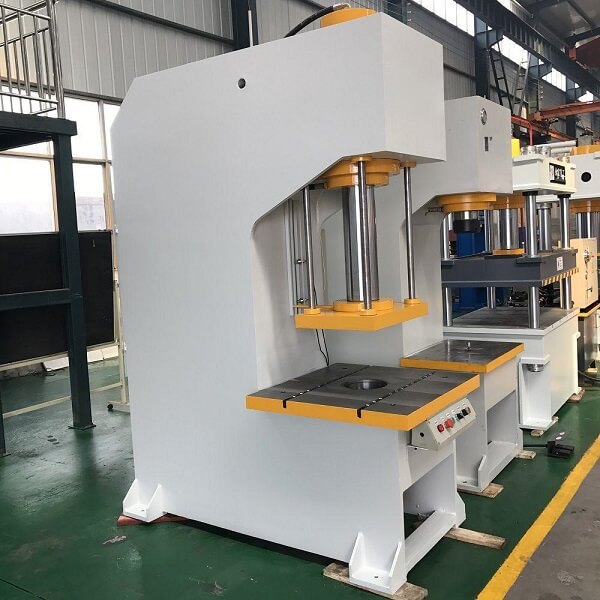
3. C Hydraulic Press Frame
The C-frame hydraulic press derives its name from its overall profile, which resembles the letter “C.” It features a unitary C-shaped steel structure combined with a slide and upper/lower platens, representing a classic design for light-duty precision machining.
A key characteristic of this frame is its three-sided open design. Workpiece access is unobstructed by vertical columns, allowing operators to easily load, unload, and adjust parts from multiple directions. Consequently, it is widely used for processes such as press-fitting, straightening, assembly, and small-scale stamping. The equipment boasts a simple structure, compact size, and a small footprint; it is easy to install and commission, and requires the least maintenance among the four common frame types.
However, because the frame relies on single-sided support, it is prone to “opening” deformation under high pressure and has limited resistance to off-center loads. This imposes certain constraints on precision and stability. Therefore, single-column hydraulic presses are typically suitable for small-to-medium tonnage applications—generally under 315 tons.
How to Choose the Right Hydraulic Press Frame
In practical terms, four-column hydraulic presses dominate the market due to their cost-effectiveness and versatility. Frame-type hydraulic presses, meanwhile, are favored in automotive manufacturing and precision forming sectors for their high rigidity and precision. Single-column hydraulic presses are better suited for auxiliary processes such as press-fitting and straightening.
When purchasing a hydraulic press, the choice of frame structure requires a comprehensive evaluation that goes beyond tonnage; factors such as product precision requirements, production cycle times, the level of automation, and future expansion plans must also be considered. Selecting a frame structure that aligns with the production process is essential to maximizing the press’s performance and achieving superior production efficiency and return on investment.
PDH is a renowned Chinese manufacturer of hydraulic presses, offering high-quality hydraulic equipment and expert industry knowledge. Please contact us if you require assistance.